As a dedicated player who has spent countless hours across both the grim, gothic landscapes of Sanctuary and the dark, unforgiving shores of Wraeclast, I find myself at the heart of a defining era for the action RPG genre. In 2026, the competition between Path of Exile 2 and Diablo 4 remains as fierce as ever, representing not just two games, but two distinct philosophies on what makes an ARPG truly great. While both titles continue to captivate millions with their loot-driven loops and visceral combat, a fundamental design choice continues to set them apart: the very structure of their worlds. From my experience, Path of Exile 2’s steadfast commitment to its instanced, procedurally generated map system isn't a limitation—it's the core of its identity and its greatest strength against Diablo 4's sprawling, seamless open world.
🔍 A Tale of Two Design Philosophies
At their core, these games are built for different, though overlapping, audiences. Path of Exile 2, developed by Grinding Gear Games, is the undisputed champion of depth, complexity, and near-infinite replayability. Its infamous skill gem system and colossal passive tree are monuments to player agency and theorycrafting. In contrast, Diablo 4 from Blizzard Entertainment prioritizes broad accessibility and cinematic, immersive storytelling. Its gameplay is streamlined, its systems more immediately intuitive, and its world is crafted to be a character in itself. This foundational difference informs everything, especially how we, as players, interact with the space around our characters.
-
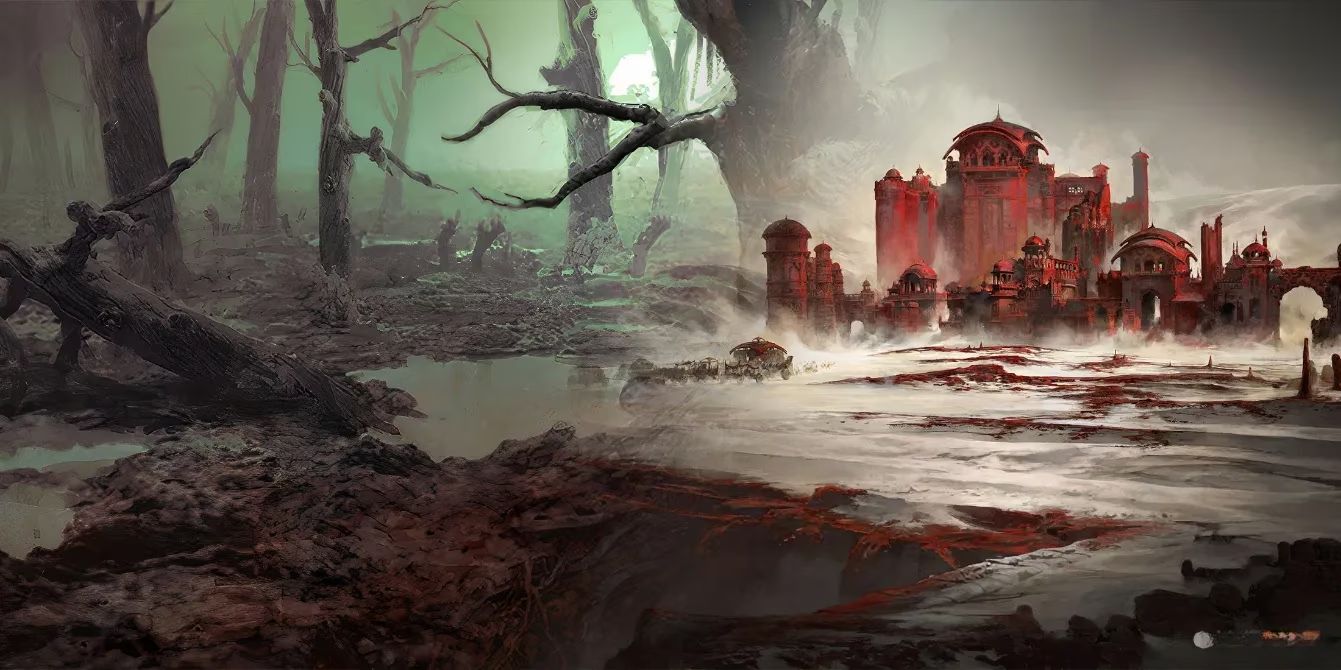
PoE2's World: Structured, instanced, and unpredictable. Towns are static hubs, but the wilds are a gamble every time you step outside.
-
Diablo 4's World: Seamless, persistent, and hand-crafted. You can ride from Fractured Peaks to Dry Steppes without a loading screen, encountering dynamic events and other players along the way.
⚔️ The Crux of the Challenge: Why Instances Define PoE2's Gameplay
Where this difference becomes most palpable is in the moment-to-moment combat and challenge. Path of Exile 2 is, simply put, a harder game. It demands a level of spatial awareness and mechanical precision that rivals the most punishing Soulslikes. Enemies are aggressive, telegraphs are subtle, and resources are precious. This intensity is directly enabled by its instanced world design.
In a tight, procedurally generated map, there is nowhere to run. You cannot simply mount up and flee to a safer part of the zone. Your survival depends entirely on well-timed dodges, strategic positioning, and the efficient management of your health and mana flasks. This creates a palpable tension that is core to the PoE2 experience. Adopting an open world like Diablo 4's would fundamentally break this combat puzzle. The ability to create distance, to kite enemies across vast plains, would trivialize the carefully tuned encounters that define PoE2's endgame.
♻️ The Engine of Replayability: Procedural Generation
Beyond combat, the instanced model is the engine that drives Path of Exile 2's legendary replayability. While Diablo 4’s open world is stunning on the first playthrough, its static nature means you'll memorize every nook and cranny of a dungeon after a few runs.
PoE2 sidesteps this fatigue entirely through heavy procedural generation. Each map in the endgame atlas is a new configuration of tilesets, monster packs, and league mechanics. This randomness ensures that no two mapping sessions ever feel exactly the same. It turns the endgame grind from a chore into a constant, engaging puzzle of adaptation and efficiency. The game's infamous economy and crafting systems are also built around this model, where the scarcity and randomness of drops in these instances create a vibrant player-driven market.
| Feature | Path of Exile 2 | Diablo 4 |
|---|---|---|
| World Structure | Instanced, Procedurally Generated Maps | Seamless Open World |
| Primary Focus | Deep Systems & Replayability | Accessibility & Narrative Immersion |
| Gameplay Pace | High-Stakes, Methodical Combat | Fast-Paced, Fluid Combat |
| Endgame Core | Atlas of Worlds (Mapping) | Nightmare Dungeons & Helltides |
| Player Interaction | Focused in Hub Towns | Persistent in Open World |
🏆 Preserving a Competitive Edge
Some have speculated that an open-world model could work for Path of Exile 2's endgame—imagine navigating the Atlas of Worlds on foot rather than as a menu. While an intriguing thought experiment, I believe this would be a catastrophic misstep. Chasing Diablo 4 on its own terms would mean diluting what makes Path of Exile 2 special. The ARPG genre thrives on diversity. The market in 2026 doesn't need another open-world looter; it needs a deep, complex, and unapologetically hardcore alternative.
Grinding Gear Games understands its audience. The players who flock to PoE2 are there for the intricate build-crafting, the economy, the sheer density of meaningful content, and yes, the brutal challenge facilitated by its confined spaces. Moving to an open world would sacrifice these pillars on the altar of trend-chasing. It would blur the lines between the two titans, ultimately weakening PoE2's unique value proposition.
💎 Conclusion: Different Paths to Greatness
Having battled through both worlds, my conclusion is clear: Path of Exile 2's rejection of the open-world formula is its greatest design strength. It is a conscious, brilliant choice that reinforces every other aspect of the game, from its punishing combat to its endlessly engaging endgame. Diablo 4 offers a breathtaking, living world perfect for getting lost in a story. Path of Exile 2 offers a ruthless, ever-changing gauntlet perfect for testing your limits and your builds.
In 2026, both approaches are not only valid but essential. They represent the two healthy poles of the ARPG spectrum. For me, the claustrophobic halls of a corrupted Temple map in PoE2, where every corner could spell doom, will always deliver a thrill that a scenic ride across Sanctuary cannot. The path less traveled—the instanced, procedural path—is what keeps Wraeclast feeling dangerous, fresh, and utterly compelling year after year. 🎮