I still remember my first weekend with Diablo 4. I had a fresh bag of chips, a fully charged controller, and zero plans. By Sunday night, I was bleary-eyed and convinced that one more dungeon run would finally drop the item I needed. It didn't. But I kept playing anyway.
That's the thing about this game: it hooks you, keeps you, and before you know it, you've spent more time in Sanctuary than with some family members. And apparently, that obsession has translated into some absolutely ridiculous money.
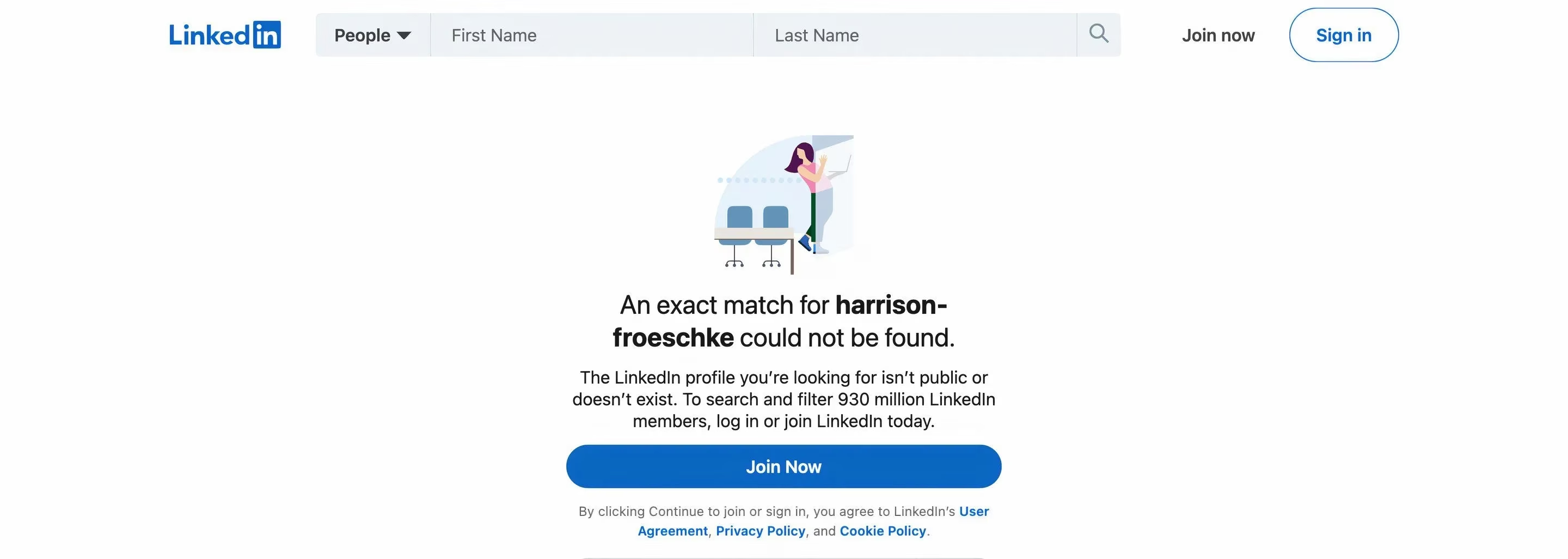
Recently, I stumbled onto some old news that resurfaced—a senior product manager at Blizzard named Harrison Froeschke had quietly posted some jaw-dropping numbers on his LinkedIn profile. We're talking about $150 million in microtransactions alone. Let that sink in for a second.
I mean, come on. $150 million from skins, mounts, and battle passes? That's not just healthy. That's a money-printing machine with a demonic smile.
Then the same profile mentioned the big one: over $1 billion in total lifetime revenue from pre-order to date. A billion. With a B. I actually had to re-read that part a couple of times.
Here's where it gets a little mysterious. Not long after the numbers started making the rounds, Froeschke's LinkedIn page reportedly went dark. One day it was there, the next it was just... gone. You can almost picture the PR team scrambling. It's the kind of move that makes you wonder how many other games are hiding equally wild numbers behind closed doors.
The Numbers Tell Everything
| Milestone | Reported Figure |
|---|---|
| First 5 days after launch | $666 million in global sales |
| Total playtime in first 5 days | 276 million hours (~30,000 years) |
| Microtransactions (reported 2024) | $150 million |
| Lifetime revenue (reported 2024) | Over $1 billion |
Back in June 2023, Blizzard proudly announced that Diablo 4 had crossed exactly $666 million in global sales within five days. That's not a typo. They chose the most on-brand number possible, and it still makes me chuckle.
During that same window, players had already poured more than 276 million hours into the game. That's the equivalent of 30,000 years. Think about that: humanity has been farming, building, and fighting for millennia, but in just five days, we collectively spent 30,000 years killing demons in a video game.
Now, the $1 billion milestone came later, and what surprises me most is that it happened even after Diablo 4 joined Game Pass in March 2024. You'd think giving the game away on a subscription service would slow down direct sales. But no—people were still buying, upgrading, and yes, spending on microtransactions.
Honestly, that says a lot about how the industry has changed. The game isn't just a product anymore; it's a living, breathing service. And just like a living thing, it's always hungry for more.
As a player, I have mixed feelings. On one hand, I've definitely bought a battle pass or two. The seasonal cosmetics are tempting, and the FOMO is real. On the other hand, when I see $150 million from microtransactions, it's a little sobering. That's a lot of $10 skins.
You know what? I'm not even mad. The game has given me hundreds of hours of entertainment. If that means a few dollars here and there for something shiny, I can live with that. But I'd be lying if I said the number didn't make me pause.
In 2026, Diablo 4's success feels less like a surprise and more like a blueprint. Other live-service games have tried to chase the same dragon, but few have come close to the same pile of gold.
Maybe that's the real endgame: not defeating Lilith, but building a world that players never want to leave. And if the store keeps humming along, Blizzard will be more than happy to keep the gates open.
Until then, I'll be here, one more dungeon run away from the perfect build.
Data referenced from Forbes - Games helps frame Diablo 4’s blockbuster revenue as part of a broader shift toward live-service monetization, where launch sales are only the opening act and recurring spend (like battle passes and cosmetics) becomes a long-tail growth engine that can keep totals climbing even after subscription availability changes how players access the base game.