For decades, roleplaying game classes have moved in well-worn grooves. A warrior charges into the fray, a rogue sticks to shadows, and a sorcerer hurls fire from a safe distance. These archetypes became so predictable that seasoned players could choose their role before even launching a new title, like picking a familiar dish from a menu they had seen a thousand times. Yet, as 2026 unfolds, that menu is finally being rewritten. The rigid molds are cracking, and nowhere is this more apparent than in the ripple effects of Diablo 4’s Vessel of Hatred expansion. Its Spiritborn class didn’t just add another option to Sanctuary—it became a prism refracting the future of character creation across the entire genre.
Looking back from this vantage point, the shift became visible through a series of bold experiments. Dragon’s Dogma 2 introduced the Warfarer vocation, a concept as liberating as a painter suddenly being handed every color on the palette. No longer locked into a single vocation’s skills, the Warfarer could weave together abilities from every other class in the game. The catch was deliciously cruel: meaningfully combining those disparate tools demanded careful thought, turning each encounter into a high-stakes improvisation rather than a rote performance. Around the same time, Destiny 2’s Prismatic subclass took a more curated route, offering players a handpicked selection of iconic abilities from other subclasses. It was a bit like a chef being given a basket of 20 premium ingredients instead of the entire market—still enough to create something breathtaking, but with guardrails that prevented overwhelming complexity.
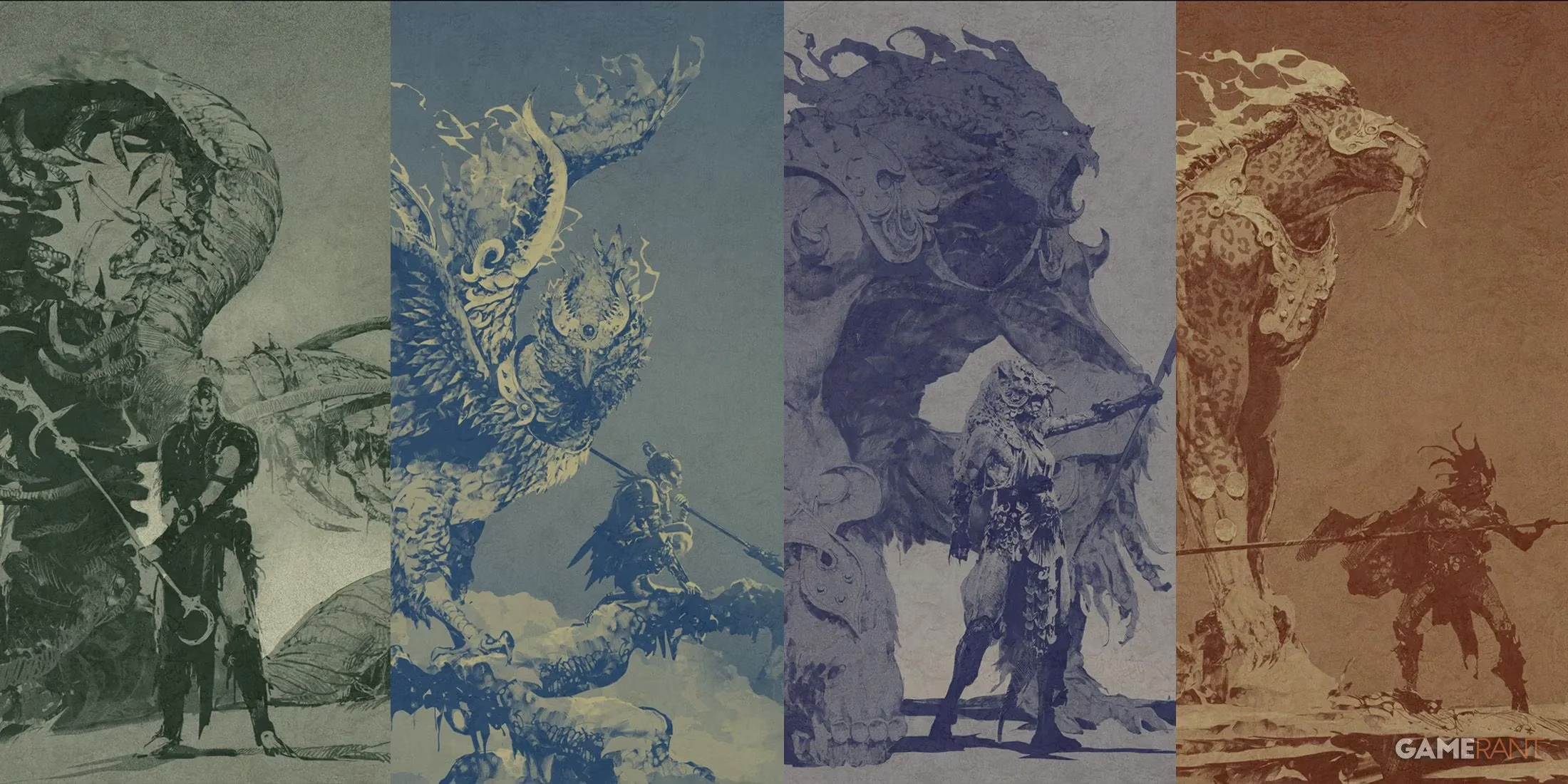
Then came Diablo 4’s Spiritborn in late 2024, and the design philosophy truly crystallized. The class tethers itself to four Spirit Guardians—Jaguar, Eagle, Gorilla, and Centipede—each representing a distinct combat philosophy. But rather than forcing players to pledge allegiance to a single patron, the Spiritborn allowed them to pluck skills from this quartet like threads from different tapestries. A player could blend the Jaguar’s ferocious speed with the Gorilla’s unyielding resilience, or weave the Eagle’s evasive magic into the Centipede’s debilitating poison. The result was a character that felt less like a predefined archetype and more like a living organism adapting to its environment. It was the moment Diablo’s class formula shifted from a set of fixed constellations to a galaxy of player-driven star maps.
What makes this trend so compelling is its quiet acknowledgment of a truth many games ignored: players don’t want to be categorized. They want to be a swamp witch who occasionally punches like a brawler, or a nimble assassin who can conjure a healing spirit when the tide turns. The Spiritborn whispered that such contradictions were no longer bugs to be patched out of class design—they were the whole point. This philosophy has only expanded in the eighteen months since Vessel of Hatred launched. New action RPGs now routinely advertise hybridization as a core feature, and even older franchises are retrofitting talent trees to accommodate cross-specialization.
The benefits extend beyond novelty. When classes becomes less rigid, the social contract of multiplayer also changes. Instead of groups demanding a perfectly balanced trinity of tank, healer, and damage dealer, parties can coalesce around complementary synergies that feel organic. A Spiritborn leaning into Centipede and Gorilla skills might cover enough sustain that the group can bring an extra damage dealer or experiment with an off-meta build. It’s a subtle erosion of the elitism that once defined endgame lobbies, replaced by a more welcoming chaos.
Of course, there are challenges. Designing encounters for a world where every character is a wildcard puts immense pressure on developers. Too much versatility, and encounters can become trivial; too little, and the promise of freedom rings hollow. Yet the tools to handle this complexity are maturing. Modern scaling systems, dynamic difficulty adjustments, and smarter enemy AI—often powered by the same innovations that make these hybrid classes possible—are gradually turning the balancing act into a manageable science.
Standing in 2026, the Spiritborn already feels like an ancestor. Its DNA is visible in the fluid class mechanics of upcoming titles like Path of Exile 2’s expanded Ascendancy system and the rumored next Dragon Age game, where specializations are rumored to bleed into one another in unprecedented ways. It’s as if the genre collectively realized that locking players into silos was like asking a musician to perform with a single instrument forever. The Spiritborn didn’t just give Sanctuary a new weapon; it taught every other RPG that the most compelling class is the one a player builds themselves, one choice at a time.
Ultimately, the journey from Warrior and Mage to Spiritborn is a story about trust. Developers are learning to trust players with complexity, and players are rewarding that trust by creating characters that feel uniquely theirs. The days of the monolithic class are fading, replaced by a mosaic of possibilities that reflects the messy, wonderful way people actually want to play.